Negative impact of Fair Value is here!

July 29, 2008Australand hit by revaluation, writedown

CapitaLand’s Aussie unit’s half-year earnings slide 79% to A$25.6m

Property revaluation and project writedown have resulted in CapitaLand’s Australian subsidiary, Australand, reporting a 79 per cent year-on-year fall in net profit to A$25.6 million (S$33.4 million) for the half-year ended June 30, 2008.

July 29, 2008Oceanus interim gain halves to 21.3m yuan on goodwill writeoff

Oceanus saw its net profit for the first six months of this year halved from 44.09 million yuan a year ago to 21.27 million yuan, due largely to a hefty goodwill write-off of about 150 million yuan arising from its reverse takeover of TR Networks in April.


As a new accountant.. Part C

Good morning, I wish to focus on Accounting Estimates and the need to review them for bias.

I participated in a few rounds of discussion with a client recently on the basis of estimates done for various balance sheet items.

On occassions, you could be in a position where you could be pressured to accept the basis amd thus values of estimates and pass the necessary entries to reflect them on the balance sheet.

How would resolve the situation without losing your job?

As a new accountant.. Part B

the railway station

I wish to focus on journal entries and other adjustments today.

  • We need to have some understanding of the whereabout of key controls over the recording and processing of journal entries.
  • Keep an eye on material journal entries and other adjustments at end of reporting period during the course of preparing the financial statements. Eg. top-side entries, consolidating and eliminating adjustments and other closing journal entries such as reclassifications.
  • Is there a specific file holding journal entry vouchers with proper authorisation?

As a new accountant.. Part A

things people will do for their business

When one is hired/appointed to a new position in a new company, please keep your eyes and ears open to the following areas when you are being briefed on your new responsibilities by your new colleagues.

  1. You should obtain an understanding of the business and its environment.
  2. You should obtain an understanding of the business’s accounting processes.
  3. Are there opportunities that controls may be incomplete, non existent or overrided?
  4. What is the money flow for the business? Follow the money!
  5. Focus on other key areas of potential risks in journal entries, accounting estimates and significant transactions.

Be careful.

Financial Reporting Process (FRP)

a wall of orchids.. not china wall

What is FRP?
Essentially FRP is the processes, procedures and controls that the management rely on in doing the following tasks:-

  • performing accounting period close
  • preparing the financial statements
  • reviewing and approving the financial statements

We need an understanding of how key judgements are made.

Why is understanding the FRP critical to Audit or to you, a newbie Accountant joining the management team in a new company?

  • FRP is where management is more likely to manipulate the financial statements. It is often more difficult to manipulate routine transaction entries.
  • FRP forms the foundation for other systems and processes within the company.

As a new management staff, while it may take some time before you get a complete feel of the decision process, it is also utmost critical that you get to know it soon. Why? You are responsible for all things big and small from the first day you start work in that office.

Take care.

FRS 10 Events after balance sheet – Summary

Events after the balance sheet date are those events, favourable and unfavourable, that occur between the balance sheet date and the date when the financial statements are authorised for issue.

Two types of events can be identified:

(a) those that provide evidence of conditions that existed at the balance sheet date (adjusting events after the balance sheet date); and
(b) those that are indicative of conditions that arose after the balance sheet date (non-adjusting events after the balance sheet date).

Things you got to know for FRS 10:-

  • When are financial statements authorised for issue?
  • Can you name some examples of adjusting events?
  • Can you name some examples of non-adjusting events?

What is your personal effective tax rate?


For those who have submitted your income tax return in April, have you received your notice of assessment yet? Can share with us your tax payable 🙂

In Feb 2008, Mr Sum Yee Loong of Deloitte & Touche presented the following statistics.

If you are an employee married with two children and earns a gross annual remuneration of $100,000, your effective tax is only 3.98%. The other countries cited:-
– Hong Kong 5.15%
-USA 5.35%
– Malaysia 19.26%
– China 20.84%
– India 31.88%

However, if you are an employee married with two children and earns a gross annual remuneration of $200,000, your effective tax would more than doubled to 9.13%. The other countries cited:-
– Hong Kong 11.08%
-USA 14.46%
– Malaysia 23.54%
– China 26.91%
– India 32.94%

Conclusion
While the change in effective tax rate is very high for Singapore for the two income brackets studied, Singapore still offer the lowest effective tax rates for your personal income.

What is your effective tax rate?

R&D Tax Allowance (RDTA)

New allowance is deductible from Chargeable Income effective YA2009 – YA2013.

It is capped at 50% of the first $300,000 of Chargeable Income.

RDTA Computation

Chageable income
Less – RDTA set off
—————————-
X
Less – Partial Exemption
—————————-
Net Chargeable Income (A)
====================

RDTA = 50% of A
Max – $150,000

Basic guidelines of how RDTA works
1. Compute RDTA for Year 1
2. Year 1 RDTA is available for setoff against net Chargeable Income for Year 2, 3 and 4
3. Any unutilised RDTA would be “lost” after 3 years
4. The setoff amount is the lower of RDTA OR incremental R&D expenditure by company for the year.

What is “incremental” R&D expenditure?

Example
R&D expenditure for YA2009
Less – R&D expenditure for YA2008
————————————–
Incremental R&D expenditure
==========================

S14D R&D

R&D expenditure now qualify for 150% deduction with effect from YA2009 – YA2013.

The R&D may not be related to the existing business / trade.

Mr Sum Yee Loong (assuming I heard him correctly) thus advised that if you want to start a new business with some R&D activities, you should it as a division in the existing business first.

You may push the division out as a separate business later.

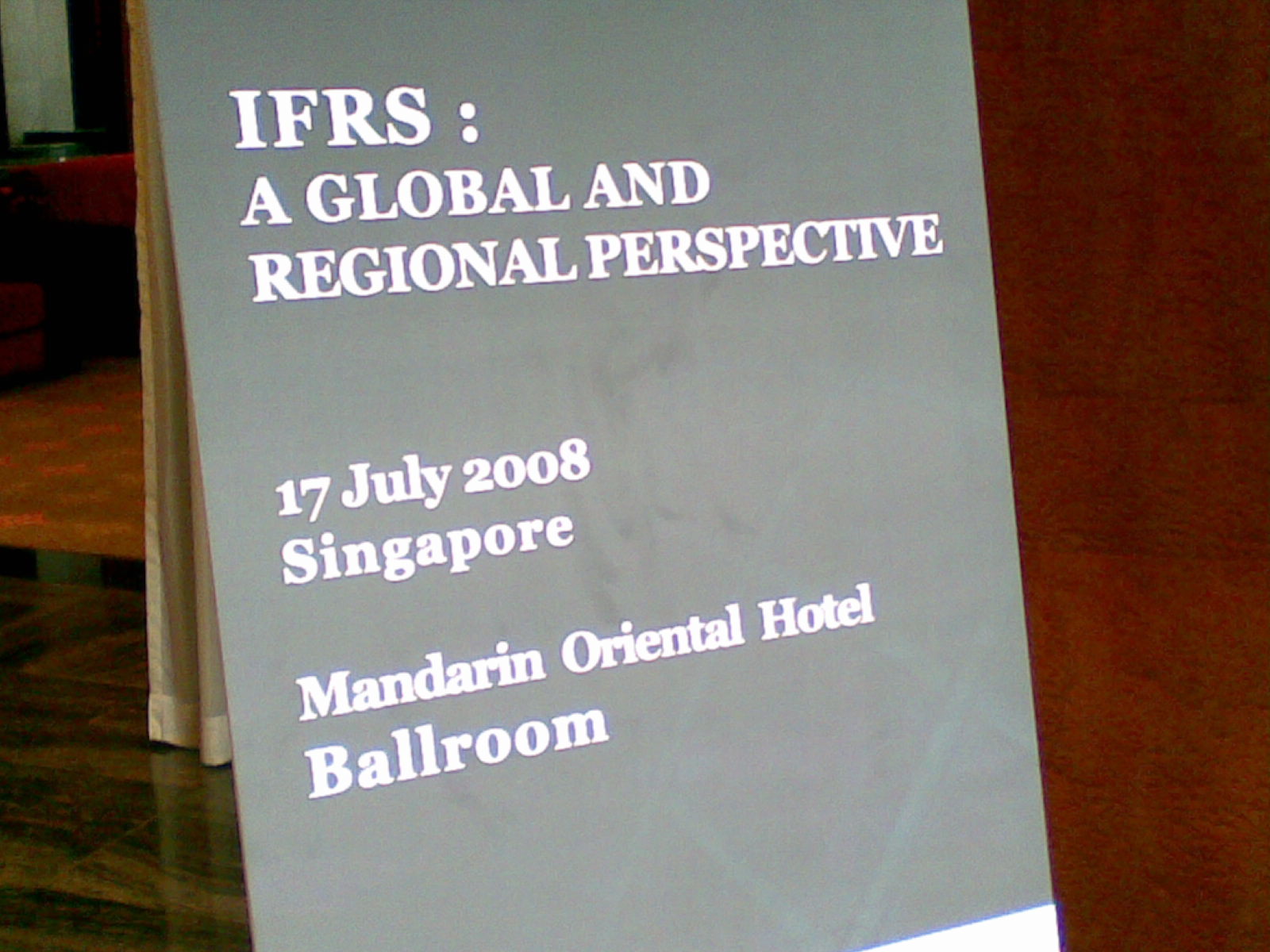
IFRS Conference – Fair Value


The following were some points made by the participants of the Conference with regard to the issue of Fair Value and various practical difficulties experienced.

1. How to value each component of a financial instrument?
A company owns Convertible Loanstocks of a blue chip borrower.
For liquidity reason, a company may consider selling away the bond portion of the Convertible Loanstock to get some cash while keeping the right to convert the loan to shares. This is to allow them to participate on the upside of the blue chip borrower. And you are ask to value the instruments in parts. How to do it?

2. Fair Value, Tax and Cashflow
Mr Eugene Wong, Managing Director of Sirius Venture Consulting said fair value gives rise to volatility in earnings. Companies in Singapore may be facing the situation where they have paid 20% tax on increased valuation gains last year and get tax deductions calculated at 18% of valuation losses this year.

3. Is there anything that may aid the practitioners in understanding and applying Fair Value?
Mr Foo of Foo Kon Tan asked. Ms Judy Ng of DBS Bank suggested that there should be qualitative disclosures on the assumptions used in arriving at the fair value and also state the sensitivity of a particular assumption to market forces.

4. Mark to market
FRS39 calls for those assets available for sale to be marked to market. How do you do that when the market is thinning/illiquid or when the market has disappeared? Can you get an answer from the auditors? Nope.

In conclusion – Well guys, we are inventing the rules as we play.