Budget Chat 1 – Just like after 2nd World War

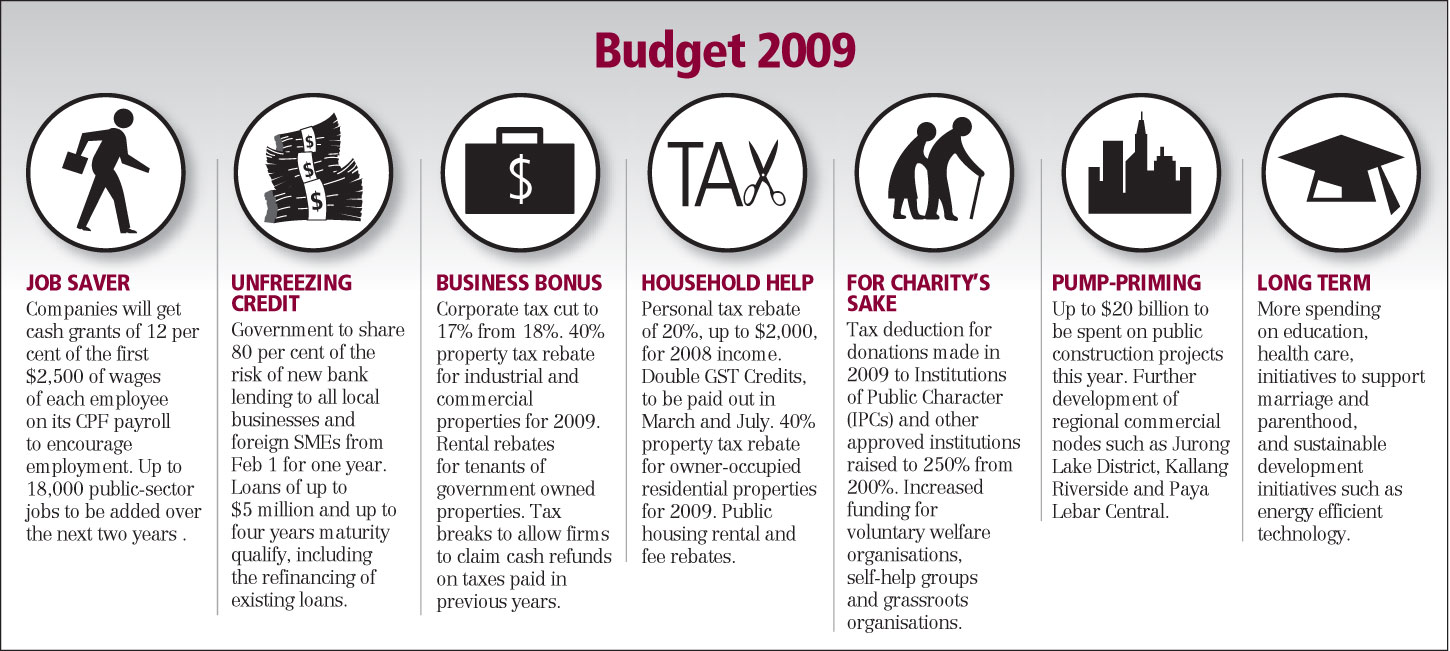
pic from Business Times

Before the release of the Budget, many were wondering what can the government do to help the economy in the absence of external demand?

On Thursday 22 Jan 2009, the Budget presented looks like a modified version of the efforts to revive a war-ravaged economy of a country immediately after the world war.

At that time, there was obviously no external demand and many of the surviving population were unemployed and living in poverty. The government then used borrowed money (from World Bank I think) to pay labour and materials to build roads, bridges and our now famous HDB flats!!

In today‘s Singapore, we are planning to use part of our reserves to partially pay for all our salaries (Jobs Credit Scheme) and another $20billion for construction projects.

For the Jobs Credit Scheme, the government will give cash grants of 12% for the first $2,500 salary of a Singaporean employee. So if your gross salary is $1,800, your boss will get a refund of $216 per month from the government.

My immediate off-the-cuff response would be that all of us will be partially working for the Government ie. part-time civil servants!!

Based on YA 2007 figures, there were about 825,000 residents who reported income tax. Assuming 300,000 are non-Singaporeans, at $200 cash grant per person per month for about 500,000 Singaporeans, it is certainly no small sum.

Definitely a bold budget indeed.

P/S – Singapore Budget 2009 May I know the person who came up with “Jobs Credit Scheme” idea?

Suggestion to IRAS

where was i?

There is a significant difference in value placed on a gardener and a household servant in the computation of taxable benefits granted to an employee.

Current laws

  • For a gardener, it is $35 per month or actual wages paid by employer, whichever is lower.
  • Whereas for a household servant, it is based on the actual wages paid by employer.

Refer – www.iras.gov.sg/irasHome/page03.aspx?id=3638

Perhaps the “discrepancy” could be due to:-

  • the gardener’s thingy has been around since the British colonial days where expatriates stayed in bungalows with gardens groomed by gardeners getting $35 salary
  • the household servant is a more recent phenomenon
  • or is it that gardeners are part-timers who come around once a while to touch up on your garden

Whatever it is, I am just trying to cheekily explain the “discrepancy” in IRAS’ valuation of a gardener as compared to a household servant.

So can I advise expatriate employees (if there is any left) to ask their employers to hire “gardeners” who can do household chores to effectively lower your taxable employment income? 🙂

s207 (9a) Companies Act and NEL Group


What is that about?
Under the Act, the external auditor of a public company has a legal duty to report (ie. whistle blow) to Minister of Finance if potential fraud may have been uncovered during the annual audit exercise.

What if it turned out to be misunderstanding? No breach of legal duty if it is done in good faith.

s207 (9a) was seldom invoked. The last time it was used was about 12 years ago on CAM International Holdings Ltd. Recently it was invoked for NEL Group. KPMG has submitted a report to the Minister.

So what do KPMG think has happened in NEL Group?
Apparently there is this new game in town called “round tripping”. It was played by NEL Group and Advance Module, another listed company back in 2005.

How to play? First I sell to you. Maybe after my financial year end, you sell back to me at about the same price. Of course, nothing was really purchased or sold except maybe some people just do and exchange some paperwork on the “transaction”.

The pressure to perform financially has encouraged creativity!

Capture Theory

roaring biz

I am required to explain Capture Theory in my coming 3rd year class on Accounting Theory. The theory is used to explain the necessity of regulation in the disclosure of accounting information and the dynamics between the Regulator and the regulated.

What is Capture Theory?
The regulated party seeks to take charge (capture) of the Regulator with the intention that the rules subsequently released by Regulator will be in favour of the regulated party.

In more human language, I would paraphrase by saying, “Those people you are out to control in the first place, actually taken control of you.”

Can Edgar relate the Theory to some real life applications in Singapore context?
National Wage Council is a tripartite entity made up of the employers, the union representatives and the Government. A tripartite entity would ensure nobody get “captured”.

Under Code of Corporate Governance, the Board of Directors are required to be represented by independent directors too. Whether the independent directors are “captured” by directors who are in executive positions/representing majority shareholders are less clear and it varies from company to company.

In the recent ACCA conference, there was a rallying call from a leading accounting professional from Malaysia to fellow professionals and interest groups in this region, to speak up and participate actively in the IFRS standard-setting process. I guess this is ensure that IFRS put into law are not “captured”.

Your IR8A

The Inland Revenue Authority of Singapore (IRAS) encourages all employers to join the Auto-Inclusion Scheme for Employment Income. It is a scheme where employers submit their employees’ income information to IRAS electronically.

The employment income information will be shown on the employees’ electronic tax return and automatically included in their income tax assessments.

Well if things go according to plan as above, all parties involved ie. employer, employee, IRAS and the mother Earth will be all happy.

But what happen when there has been an error or omission in the employer’s submission?

For any omission/error in the Form IR8A, the penalties for any tax understated are imposed on the employer for a failure to report.

However, penalties may also be separately imposed on the employee for failure to report in his personal tax return. You can’t argue with IRAS that the mistake was committed by your employer.

Remember you are the person who finally submit the return!

The End of Double Entry?

the start of Bintan golf

I am reading a couple of textbooks at the same time for the new term of 2009. I wish with you these few interesting paragraphs challenging the existence of the double-entry system.

The books that I am reading credited the first organised written thought on double entry system to this Franciscan monk called Luca Pacioli and his now famous work called “Summa de Arithmetica, Geometrica, Proportioni et Proportionalita” published in Venice back in 1494. It is simply a system of debits and credits, where the debits going to the left and credits going to the right. It is a system of subtraction-by-opposition ie. put on the opposite side if you want to minus.

Then a clever chap (possibly someone who cannot handle double entry) asked, “Why can’t we use positive and negative numbers instead of T-accounts?”

So if you want to pay salary, you just add to Salary expenses and minus the same amount from the Cash/Bank.

FYI – negative numbers were only accepted in the mathematics world in 17th century while double entry has been around since 13th/14th century.

In the 21st century’s classes of Edgar, both systems are used in our learning programmes.

P/S – http://accountingwithedgar.blogspot.com/2007/09/origin-of-debit-credit.html

Gold farmers?


Who are they?
Players who repetitiously slay virtual monsters in online games in order to earn virtual “gold” and “equipment”. Such winnings could be sold for real money offline.

Some of them could do so well at this that they are able to hire “employees” to run errands such as buying lunches/drinks and collecting money from buyers from all over Singapore.

Are the taxman interested in the income?
Definitely yes. Korea National Tax Service taxes these farmers up to 40% on their profits. China authority arrived in Oct 2007. Singapore’s IRAS said such income is definitely taxable.

But I wonder who in Singapore with this vocation has actually declared and paid taxes on their income? If you had, please share with the details.

Why is it taxable?
Under Tax 101, we learned the “badges of trade”. Of the six badges, these two would nail the farmers ie.

  • frequency or number of similar transactions by an individual
  • the essence of a profit seeking motive

Now I got to go check on my children playing on their computer games!!

Source – yesterday’s ST pp 2

What is a business’ commencement date?


I am duly notified today that IRAS has issued a directive in an attempt to define a business’ commencement date.

What is the definition of the business’ commencement date?
It is only when the business has established its profit-making structure and started its
first commercial activity that it can be regarded as having commenced operation.

What is profit-making structure?
No specific definition. It depends on the nature of the business. IRAS has however provided several examples in the directive.

If you were runnning a supermarket, it commences business when it opens its door and offers its goods for sale to the public. It is definitely not the date of opening ceremony.

For a manufacturing entity, it is the date the entity is in a position to start its first commercial production.

The start date for a hotel is simpler. It is the day it receives the certificate of registration.

A property developer seems to be getting a rough deal. The business commences when it buys its first piece of land or building for sale.

For a set up to provide professional service, it is deemed to have started business when it is ready to commence marketing activities. So if you are still in the midst of hiring staff and putting your office together, you have not started your business yet.

In case of doubt, you can always write in to IRAS for assistance.

KPMG – Press Release – Sep 2008 – Summary


Mr Owi Kek Hean, Head of Tax Services at KPMG in Singapore highlighted the following key trends.

Firstly, indirect tax rates on the whole have not changed, while corporate tax rates have been
pushed steadily down.

Secondly, more and more governments are introducing indirect tax systems. There are currently
135 countries with these systems in place and more in the pipeline.

Thirdly, there is a steady expansion of the transactions that these taxes are applied to, and a new focus from tax authorities on efficient collection of indirect taxes through corporate tax
departments.

Fourthly – Enforcement is on the rise.
If your business is making GST supplies of S$1 billion or more, you are entitled to access its GST
Compliance Assurance Programme. This programme involves visits by specialist revenue authority officers to large businesses to assist with issues of GST accounting, record keeping and reporting.

Interesting facts on Asia Pacific countries:-
Corporate tax rates – Highest – Japan with 40%, Lowest – Macau 12%
Indirect tax rates – Highest – Pakistan 20%, Lowest – Japan 5% (Sweden – 25%)