FRS 10 Events after balance sheet – Summary

Events after the balance sheet date are those events, favourable and unfavourable, that occur between the balance sheet date and the date when the financial statements are authorised for issue.

Two types of events can be identified:

(a) those that provide evidence of conditions that existed at the balance sheet date (adjusting events after the balance sheet date); and
(b) those that are indicative of conditions that arose after the balance sheet date (non-adjusting events after the balance sheet date).

Things you got to know for FRS 10:-

  • When are financial statements authorised for issue?
  • Can you name some examples of adjusting events?
  • Can you name some examples of non-adjusting events?

IFRS Conference – Fair Value


The following were some points made by the participants of the Conference with regard to the issue of Fair Value and various practical difficulties experienced.

1. How to value each component of a financial instrument?
A company owns Convertible Loanstocks of a blue chip borrower.
For liquidity reason, a company may consider selling away the bond portion of the Convertible Loanstock to get some cash while keeping the right to convert the loan to shares. This is to allow them to participate on the upside of the blue chip borrower. And you are ask to value the instruments in parts. How to do it?

2. Fair Value, Tax and Cashflow
Mr Eugene Wong, Managing Director of Sirius Venture Consulting said fair value gives rise to volatility in earnings. Companies in Singapore may be facing the situation where they have paid 20% tax on increased valuation gains last year and get tax deductions calculated at 18% of valuation losses this year.

3. Is there anything that may aid the practitioners in understanding and applying Fair Value?
Mr Foo of Foo Kon Tan asked. Ms Judy Ng of DBS Bank suggested that there should be qualitative disclosures on the assumptions used in arriving at the fair value and also state the sensitivity of a particular assumption to market forces.

4. Mark to market
FRS39 calls for those assets available for sale to be marked to market. How do you do that when the market is thinning/illiquid or when the market has disappeared? Can you get an answer from the auditors? Nope.

In conclusion – Well guys, we are inventing the rules as we play.

FRS for SMEs


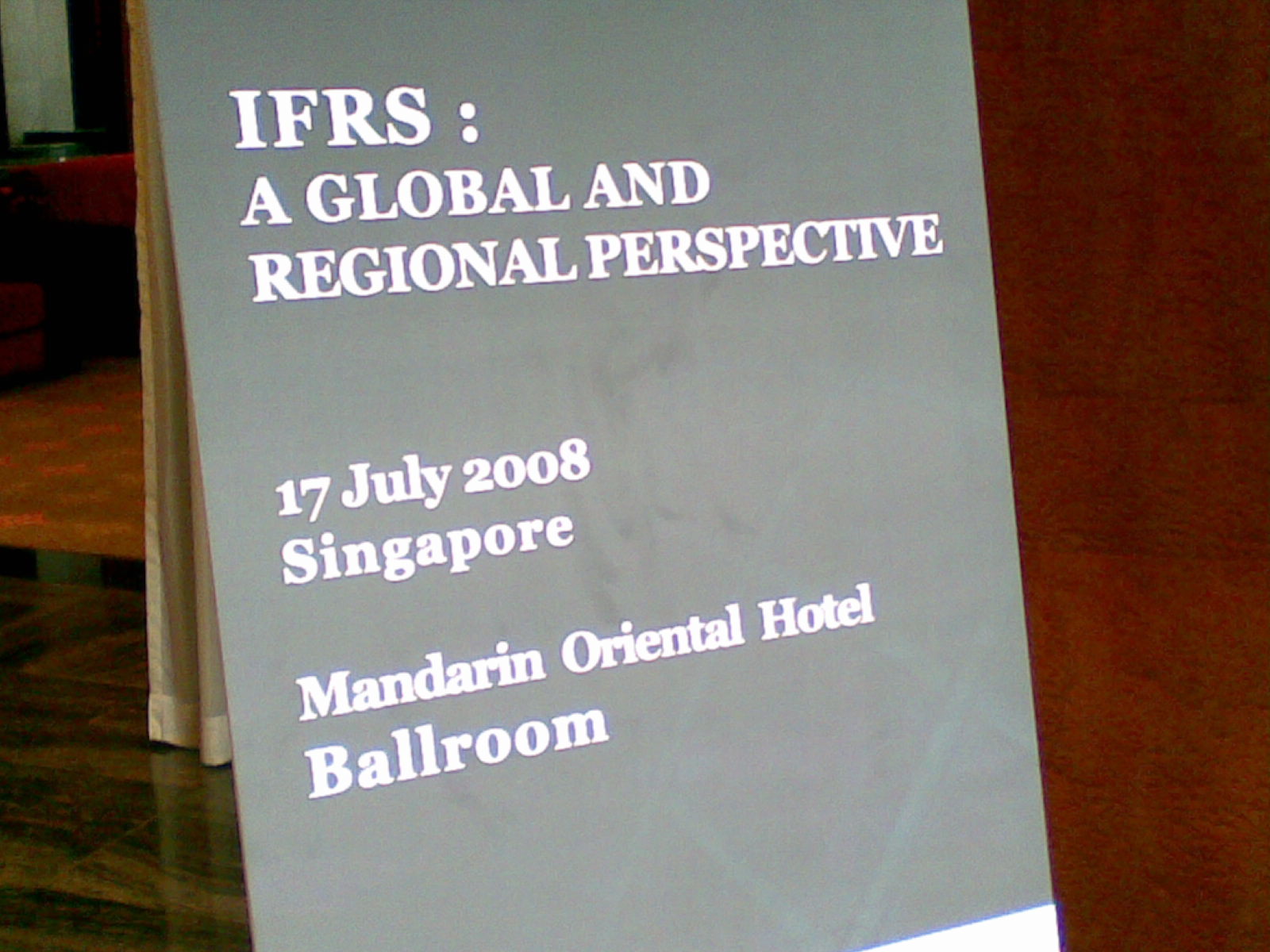
While we are eagerly awaiting for the launch of FRS for SMEs in Singapore, there are changes to IFRS’s version as outline in recent IFRS Conference held on July 17, 2008 in Marina Oriental Singapore.

First and foremost, IFRS said there is going to be a name change from IFRS for SMEs to IFRS for PRIVATE ENTITIES. Warren McGregor gave some background info on the proposed name change.

The IFRS for SMEs is definitely not for the mom-and-pops businesses but rather caters to entities with 50 or more employees in general. They were considering other names like non-publicly accountable entities.

The IFRS for Pte Entities will be fully stand alone ie. no reference to the main/full FRSs.

Accounting for Leases

In the IFRS conference held on July 17, 2008, Sir David Tweedie and Warren McGregor said IASB is working towards abolishing the need to differentiate between finance lease and operating lease.

The Board is taking the approach of “right of use” in crafting the new FRS on Leases. With this approach, it would be reflected as an Asset as long as the lessee has the right of use and consequently mirrored as a Liability as long as the lessee has an obligation to pay.

The Board faces difficulties in sorting out the following features in a lease agreement:-
– option to renew or terminate a lease
– measurement eg. contingent rentals
– overlap with other projects in the area of revenue recognition, derecognition and conceptual framework.

Sir Tweedie made an interesting remark. He said he is looking forward to the day when he could say that he is flying in a plane that is actually reflected in the airline’s balance sheet.

IASB and FASB are doing something together.

Marina Viaduct’s skyline now

Who are they?
IASB – International Accounting Standards Board
FASB – US’s Financial Accounting Standards Board

What have been doing together?
Essentially trying to move the two standards together.
They are planning to do it over 3 phases ie. A, B and C.

What are the 3 phases?
Phase A – completed in Sep 2007 with the issuance of FRS 1R. The FRS introduces the use of some American terminologies. The use of these terms for Singapore is not compulsory. Thus expect confusion in Singapore. Examples,
– Balance Sheet is “Statement of Financial Position”
– Cash Flow Statement is “Statement of Cash Flows”

Phase B
Mr Yeoh Oon Jin, Assurance Leader, PwC Singapore, said the Phase will take a few years to complete and would cover areas on how to prepare the respective statements. Examples,
– what income and expenses items to be classified under which totals and sub-totals in which statements etc etc etc
– whether direct or indirect cashflow presentation should be adopted

Phase C
While they have an idea of what they want to do, no point remembering them as it would too long down the yellow brick road for any certainty of being effected.

Reference – ACCA Focus Q2 2008 pp13-15

FRS 7 Cash Flow Statements – Summary

FRS 7 prescribes the principles in preparing cash flow statements.

The standard requires the provision of information about historical changes in cash and cash equivalents of a company by means of a cash flow statement that classifies cash flows during the period by operating, investing and financing activities.

Operating activities are the principal revenue-producing activities of the enterprise. Cash flows from operating activities are disclosed either using the:-

a) direct method (disclosure of major categories of gross cash receipts and payments); or

b) indirect method (profit or loss for the period is adjusted for non cash items (such as depreciation, foreign exchange losses etc.) and income or expense related items related to investing and financing activities to determine the operating cash flows.

Investing activities are those expenditures incurred with an intention to generate future income and cash flows.

Financing activities are those expenditures incurred that result in changes in the size and composition of the contributed equity and borrowings of the entity.

“Do you know the definition of “cash and cash equivalents”? Can you name some examples of cash equivalents?”, ask Edgar.

Source – ICPAS ePublication 22 November 2005 Issue 11/2005

FRS 8 Accounting Policies, Changes in Accounting Estimates and Errors – Summary

The objective of FRS 8 is to prescribe the criteria for selecting and changing accounting policies, together with the accounting treatment and disclosure of changes in accounting policies, changes in accounting estimates and correction of prior period errors.

Changes in accounting policies
An entity should change its accounting policies only if the change is required by the Standards or the change results in a more relevant and reliable information about the entities financial position. Any changes in accounting policies shall be accounted for in accordance with the specific transitional provisions of the Standards. If there are no specific transitional provisions, the change in accounting policies shall be done retrospectively as though the new accounting policy had always been applied.

Changes in accounting estimates
Changes in accounting estimates should be recognised prospectively in the profit and loss account either in the period of the change only or the period of change and future periods, if the changes affect both. Any corresponding changes in assets, liabilities or equity are recognised by making adjustments to the carrying amount of the assets, liabilities or equity in the period of change.

Errors
Material errors in financial statements that are discovered in subsequent periods must be adjusted retrospectively in the first set of financial statements authorized for issue after their discovery. The comparative amounts for prior period are either restated or if the error occurred before the earliest prior period presented, the opening balances of the assets, liabilities and equity for the earliest prior period are restated.

FRS 8 specifies that in instances where it is impracticable to do a retrospective adjustment for change in accounting policy, the entity should restate the comparative information prospectively from the earliest date practicable.

FRS 8 also specifies the disclosures required of changes in accounting policies, accounting estimates and errors.

What is prior period errors? When did an error occur?

Prior period errors are omissions from, and misstatements in, the entity’s financial statements for one or more prior periods arising from a failure to use, or misuse of, reliable information that:-

  • was available when financial statements for those periods were authorised for issue; and
  • could reasonably be expected to have been obtained and taken into account in the preparation and presentation of those financial statements.

Such errors include the effects of mathematical mistakes, mistakes in applying accounting policies, oversights or misinterpretations of facts, and fraud.

Source – ICPAS ePublication 29 Nov 2005 Issue 12/2005

FRS 2 Inventories – Summary

Objective
FRS 2 provides guidance on the determination of cost of inventories and its subsequent recognition as an expense, any write down to net realizable value.

FRS 2 applies to all inventories except for:

a) WIP under construction contracts;
b) Financial instruments; and
c) Biological assets related to agricultural activity produce at the point of harvest.

Inventories are measured at the lower of cost and net realisable value (NRV).

  • NRV is the estimated selling price in the ordinary course of business less estimated costs of completion and costs necessary to make the sale.
  • Cost of inventories comprise of cost of purchase, costs of conversion and other costs incurred in bringing the inventories to their present location and condition.

Three methods of costing inventories are specified under paragraph 23-27 of FRS 2.

i) Specific identification of costs method

ii) First-In, First-Out (FIFO) costs method

iii) Weighted average costs method

FRS 2 requires that the amount of write down of inventories to NRV is recognised as an expense in the period the write down or loss occurs. Any reversals of the write down, as a result of increase in NRV, is recognised as a reduction in amount of inventories recognized as an expense in the period the reversal occurs.

FRS 2 also specifies the disclosures required of inventories.

Source – ICPAS ePublication

FRS 1 – Presentation of Financial Statements Nov 2005

Objectives

  1. To prescribe the basis of presentation of general purpose financial statements and;
  2. To ensure comparability of entity’s financial statements with previous periods and with other entities’ financial statements.

Below is a summary of the overall considerations for the presentation of financial statements.

  • Fair presentation and compliance with FRS

A faithful representation of the effects of transactions, events and conditions in accordance with the FRS.

  • Going concern

Preparation of financial statements with the assumption that the business will continue indefinitely.

  • Accrual basis of accounting

A method where income and expense items are recognized and recorded when income is earned and expense is incurred, regardless of when cash is actually received or paid.

  • Consistency of presentation

Presentation and classification of items in financial statements are retained from one period to the next unless the standard requires a change in presentation or there is a significant change in the nature of the entity’s operations, such that another presentation would be more appropriate.

  • Materiality and aggregation

Similar items of each material class are to be presented separately.

  • Offsetting

No offsetting of asset and liabilities, and income and expenses unless permitted by a Standard.

  • Comparative information

To disclose comparative information of previous period for comparative purposes.

FRS 1 also specifies the minimum line item disclosure required on the face of the balance sheet, income statement, statement of changes in equity and notes to the financial statements except for presentation of cash flow statements which is covered under FRS 7.

FRS 1 also specifies that entities disclose information that is presented in the financial statements such as the accounting policies, judgments and key sources of estimation uncertainty at the balance sheet date.

Source – ICPAS ePublication 8 November 2005 Issue 9/2005
Positive impact of fair value gain for Ipco

On Dec 15, 2007, BT reported that fair-value gain boosted Ipco International’s 6-month profit by more than 100% (ie. from $2.1mio ti $5,4mio on a revenue of $24.4mio) despite a 31.5% fall in first 6-month sales.

What is Ipco’s business?
Ipco is essentially a developer and investor in oil and gas, water and environment infrastructure projects.

ESA Electronic, its subsidiary in the semiconductor equipment distribution business, responsible for 31.5 per cent fall in group’s sales of goods to $11.9 million from $17.4 million.

This was offset by a rise in other revenue from $2.4 million to $8.2 million, which included $7.5 million in ‘fair-value gain’ on financial assets.
So without the fair-value gain, the Group’s total revenue would be $16.9mio instead of the currently reported $24.4mio (a 16% drop instead).

So while Labroy and SembMarine have been negatively affected by financial assets valuation, we have a company here that has been glossed with positivities instead.

P/S – Fair-value gain of $7.5mio is accounted as “Other revenue”. Hmmm…