MOM’s position on Company Stamp Part II

lingzhi

To be fair, I am presenting MOM’s response received today on Company Stamp for your consideration.

MOM said,
“Our requirement to have company stamp endorsing our documents reduces the likelihood of unauthorised transactions or applications by a third party. Such cases do happen and companies become invariably implicated or inconvenienced due to fraudulent transactions.

While there is no legal requirement for companies to have a company stamp, such a requirement will safeguard the interests of our customers such as yourself. We will also accept alternative means of authorisation such as an official company letter in lieu of a company stamp endorsement.” Unquote.

Questions for your consideration.

  1. What is a Company Stamp?
  2. Can anyone make a Company Stamp?
  3. How much to make a Company Stamp?
  4. How does a Company Stamp protect your company if it is not legally binding to use a Company Stamp in official documents and contracts?
  5. Is it different from Company Seal?

  1. What is a Company Letterhead?
  2. What are the statutory information that must be found on a letterhead?
  3. How to make Company Letterheads? Must I ask the printer to print or can I print them using my printer?
  4. When is a letterhead a letterhead and when is it not a letterhead?

If the primary objective is to prevent false or fraudulent applications and transactions, you verify the person that is making the application / transaction by checking the identity card/passport.

I don’t think a Company Stamp or Company Letterhead can prevent a fraudulent application/transaction.

Company Stamp? Do we need it?

Recently my company went into a tangle with Ministry of Manpower (MOM) over the requirement to place the company stamp on a work permit form.

I told the MOM officer that my company does not use any company stamp. The officer then requested my company to issue a letter on my company letterhead saying my company does not use company stamp.

I seek an explanation for the need of such a piece of paper with the company letterhead generated by MS Word. What is the legal importance of that piece of paper?

I seek feedback from MOM and EnterpriseOne on whether there is a legal requirement for companies to use company stamp. MOM’s email response that I seek is still pending after more 3 business days as per their explicitly stated service standard. EnterpriseOne responded the very same day. Fantastic service! EnterpriseOne simply state that company stamp is not a legal requirement.

If that is the case, why are some banks and government bodies insist on use of company stamp?

Don’t ask for things if they are not necessary in the first place. It is time to stop creating unnecessary work.

Anyone with legal knowledge, please correct me if I have mistaken. Cheers.

Tax Deferment Scheme

What is the Scheme about?
Inland Revenue Authority of Singapore (IRAS) allows taxpayers with GIRO arrangement to defer income tax instalments for 3 months, from May 2009 to July 2009.

I thought IRAS was in the same helpful mode as per Budget just presented earlier ie. delaying its collection of current tax payable due to IRAS.

But which 3 months are we talking about? May, Jun and July 2009!!! For these months, we are actually paying tax in ADVANCE ie. for YA2009. They are actually not due until we receive our Assessment after we report our income on April 15.

So IRAS, are you really helping us to alleviate our financial burden? I don’t think so.

Bottomline – You are not defering tax on money I owe you but rather you are defering on tax I am not due to pay you.

We understand better with graphics?

keep roaring!

Just read a paper from University of Chicago entitled “Human Judgement Accuracy, Multidimensional Graphics, and Humans vs Models”.

The objective of the paper was to check whether graphics aid humans in the detection of changes in firms’ performance and consequently reflect their judgement in bond’s rating of bonds from the respective companies.

So the researchers showed financial info in “boring” tabular format and then “pictorial” format to groups of people with different levels of financial accounting training.

Results

  • The research confirmed our common understanding that graphics do help with our understanding of any issue, including complex financial results.
  • This behaviour is similar to people from different levels of financial accounting training. This means that even the highly trained/”practiced” professionals would also get additional understanding.

Applications

  • So at work, can we try to present to our bosses in pictorial format ie. at least use bar charts and pie charts, to help them with their understanding?
  • If you are reading financial statments from public listed companies, they come with all the bells and whistles in term of presentation. For presentation of results to the press, go check out the powerpoints they use. You download a copy of SMRT’s if you wish.
  • Edgar should put more pictures in his notes to help his charges.

So we are kindergarten kids, basically?

Singapore Budget 2009 – My budget chats

Dear Friends,

Happy ‘Niu’ Year to you.

The Singapore Budget 2009 has been touted as bold. I do agree with this labelling to a big extent.

I have placed my comment at AccountingWithEdgar blog. My latest entry is my views on Dr Basant Kapur’s idea to roll back GST to stimulate Consumption.

So please have a read through and share with me your views and comment too.

Gongxi to you!

Is your business a Going Concern?

Are your bankers, suppliers, customers, employees… asking questions or passing remarks about your company’s health ie. going concern (GC) status?

Given the current economic situation, may businesses may display certain symptoms that they may have caught the GC disease.

There is one more key person whom you may have to contend with in due course.. the auditor!

Auditors will increasingly question the viability of business. Helen Brand, head of ACCA reinterated this point in yesterday’s BT article entitled “Going concern dilemma for auditors”.

A CFO of a public listed company that I “accidentally” had lunch with recently, made this remark about their auditor. The company has some investment in China. To check for impairment, auditor requested that his company to do a 5-year cashflow projection and to be followed by computing for its NPV using the higher Weighted Average Cost of Capital (WACC) as the discount rate. He said the end result of that exercise is obvious. There will definitely be a write down on the investment. The write down may wipe off whatever profit and resulting in a loss. A loss ==> any going concern problem?

While a loss may not lead to a going concern problem, nevertheless the loss would activate another series of tests to confirm whether a company has the ability to meet its obligations within 12 months from its balance sheet date.

A quick and simple test would be whether Current Assets > or < Current Liabilities.

A loss in the P&L and CA Qualified Audit Report => investors/bankers withdrawing their support. Unthinkable?

Business owners, you may wish to get ready the following for the GC test.

  • a realistic business plan
  • a realistic plan to liquidate non-current assets
  • a financial support package secured
  • capital injection from shareholders
  • or any other info that will help the auditor to appreciate that your business can go on for another 12 months

Both auditors and business owners do understand the gravity of GC.

Budget Chat 2 – Dr Basant K. Kapur

With reference to today’s ST “Making the case for GST roll-back” editorial by Dr Kapur, his principle position is:-

Singapore’s fiscal policy is too supply oriented.

I disagree with Dr Kapur in the following areas. Whether the budget measures are too supply-sided or demand-sided could be a matter of perception.

Keynes gave us fiscal policy measures to manage Aggregate Demand.

Aggregate Demand = Consumption (C) + Investment (I) + Government Spending (G)

My position – When I analyse the headline measures of the Budget, they are as much demand-sided as supply-sided.

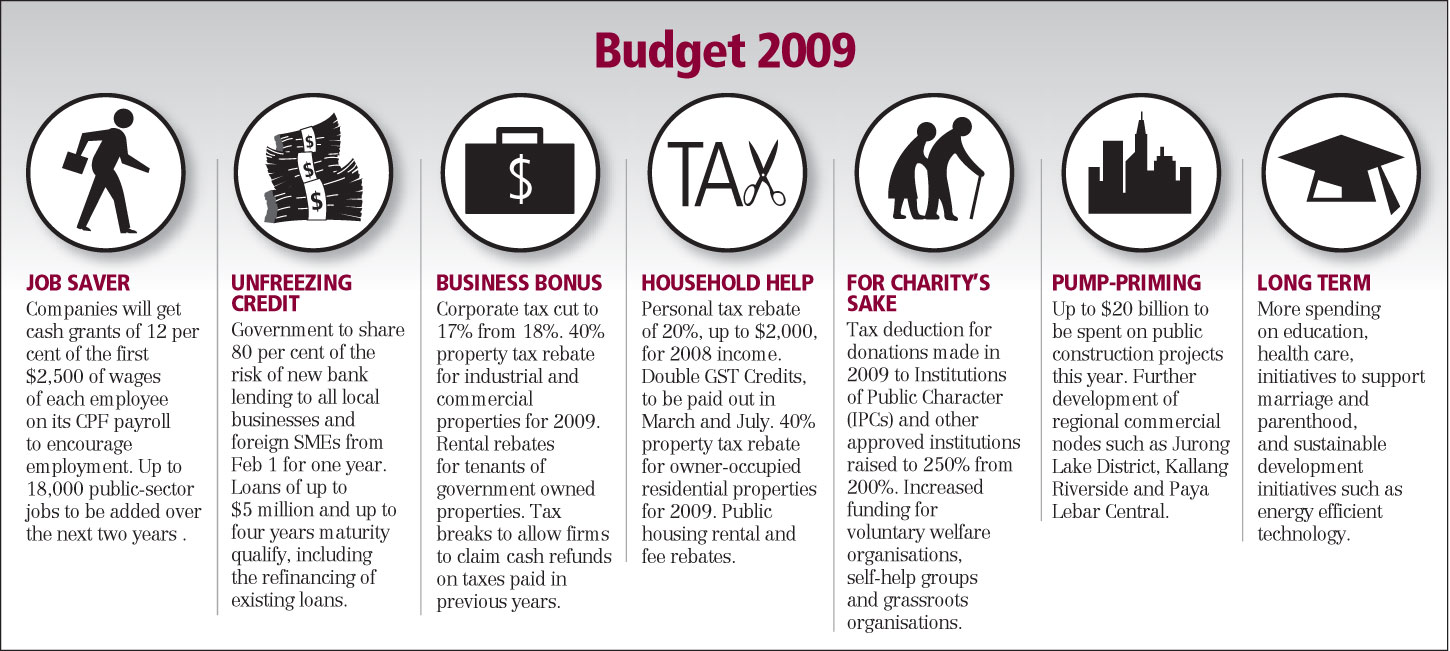
  • For the Job Credits Scheme, it is primarily aimed at maintaining the job/income for many and hopefully translate to Consumption. This is a more indirect but maybe sustainable) approach to Consumption as compare to Government just crediting your accounts with some monies. This simple-putting-money-into-your-pockets idea is also done in the form of GST credits.
  • Unfreezing Credit by provding loan guarantees – While this is a way to keep the cash flow going to pay wages, it could be viewed as a means to encourage domestic Investment demand.
  • Double GST rebates – Dr Kapur called for GST roll-back ie. reverse the 2% GST increase to stimulate domestic demand. He argued that negative “real-balance effect” of higher prices due to higher GST would curb Consumption. My views – Would the Double GST rebates achieve the same? Or as GST rebates (and Job Credits schemes) are only given to Singaporeans, does it imply that the postive impact on demand (if any) would be more muted as compared to a GST roll-back to all residents? I hesitate to agree with Dr Kapur until I am given some info on the cost to businesses in changing GST/CPF rates up and down.
  • $20billion on Construction project – Is this not a direct prescription of Keynes where we would count the intended expenditure as Government Spending (G) and/or Investment (I)? Dr Kapur is asking for 2%/$1.8billion GST roll-back. May I have your view on $20billion thingy too? While the Contractors will be happy first, I am sure when they spend the money they earn, the rest of Singapore will be happy too.
  • The longer term spending on Education, Healthcare, Marriage, Parenthood and Green theme – I would agree with Dr Kapur that these would be more supply-sided initiatives.

Other Dr Kapur’s key views to share:-
The biggest thing that is weighing down on Consumption is Housing. Given the high owner occupied properties and “high” property prices, a lot of purchasing power is directed at maintaining our place of residence.

Budget Chat 1 – Just like after 2nd World War

pic from Business Times

Before the release of the Budget, many were wondering what can the government do to help the economy in the absence of external demand?

On Thursday 22 Jan 2009, the Budget presented looks like a modified version of the efforts to revive a war-ravaged economy of a country immediately after the world war.

At that time, there was obviously no external demand and many of the surviving population were unemployed and living in poverty. The government then used borrowed money (from World Bank I think) to pay labour and materials to build roads, bridges and our now famous HDB flats!!

In today‘s Singapore, we are planning to use part of our reserves to partially pay for all our salaries (Jobs Credit Scheme) and another $20billion for construction projects.

For the Jobs Credit Scheme, the government will give cash grants of 12% for the first $2,500 salary of a Singaporean employee. So if your gross salary is $1,800, your boss will get a refund of $216 per month from the government.

My immediate off-the-cuff response would be that all of us will be partially working for the Government ie. part-time civil servants!!

Based on YA 2007 figures, there were about 825,000 residents who reported income tax. Assuming 300,000 are non-Singaporeans, at $200 cash grant per person per month for about 500,000 Singaporeans, it is certainly no small sum.

Definitely a bold budget indeed.

P/S – Singapore Budget 2009 May I know the person who came up with “Jobs Credit Scheme” idea?

s207 (9a) Companies Act and NEL Group


What is that about?
Under the Act, the external auditor of a public company has a legal duty to report (ie. whistle blow) to Minister of Finance if potential fraud may have been uncovered during the annual audit exercise.

What if it turned out to be misunderstanding? No breach of legal duty if it is done in good faith.

s207 (9a) was seldom invoked. The last time it was used was about 12 years ago on CAM International Holdings Ltd. Recently it was invoked for NEL Group. KPMG has submitted a report to the Minister.

So what do KPMG think has happened in NEL Group?
Apparently there is this new game in town called “round tripping”. It was played by NEL Group and Advance Module, another listed company back in 2005.

How to play? First I sell to you. Maybe after my financial year end, you sell back to me at about the same price. Of course, nothing was really purchased or sold except maybe some people just do and exchange some paperwork on the “transaction”.

The pressure to perform financially has encouraged creativity!

Gold farmers?


Who are they?
Players who repetitiously slay virtual monsters in online games in order to earn virtual “gold” and “equipment”. Such winnings could be sold for real money offline.

Some of them could do so well at this that they are able to hire “employees” to run errands such as buying lunches/drinks and collecting money from buyers from all over Singapore.

Are the taxman interested in the income?
Definitely yes. Korea National Tax Service taxes these farmers up to 40% on their profits. China authority arrived in Oct 2007. Singapore’s IRAS said such income is definitely taxable.

But I wonder who in Singapore with this vocation has actually declared and paid taxes on their income? If you had, please share with the details.

Why is it taxable?
Under Tax 101, we learned the “badges of trade”. Of the six badges, these two would nail the farmers ie.

  • frequency or number of similar transactions by an individual
  • the essence of a profit seeking motive

Now I got to go check on my children playing on their computer games!!

Source – yesterday’s ST pp 2