Category / News
Do on to yourself,
… what you have been doing on to others.
Well I am referring to the decision by IRAS to pay interest to you should they fail to issue tax refunds to you within 30 days.
At what rate? Average prime rates.
Kudos to IRAS.
GST Advance Ruling System (GST ARS)
What is that?
When you seek guidance from Comptroller of Goods and Services Tax (“CGST”) in writing, CGST’s reply in writing becomes an authority you can rely upon ie. legally binding.
The actual definition:-
An advance ruling is a written interpretation the CGST gives to a specific person, stating how specific provisions of the GST Act will apply for a particular business arrangement or a specific transaction.
You would not ask ARS to be applied on daily-bread-and-butter issues where they are sufficiently covered/explained under existing terms.
You would use ARS for complex business arrangement or a transaction that is never or not commonly done in Singapore before.
So what had CGST been doing in the past?
Just provide guidance that are not legally binding to entrepreneurs seeking affirmation that they are not breaking any laws or impact their bottomline estimation.
What is this applicable?
The new section 90A, together with a new Fifth Schedule, will be enacted and effective from 1 July 2007.
Any fees payable?
Of course, this is Singapore, you know. Albeit on a cost recovery basis.
From a fixed application fee, to possible hourly rate, any disbursements, fees payable for expertise needed but not available in IRAS etc etc.
NKF – When auditors are not up to mark
- independent directors,
- audit committee and;
- internal auditors.
- NKF’s assets and reserves are largely intact.
- There were some but not crippling excesses by its ex-chief executive.
- NKF is still functioning and serving its patients today.
- PwC had been charging NKF a nominal annual audit fee of $35,000 as compared to hundreds of thousands dollars chargeable for similar audits.
- KPMG too charged NKF a nominal fee of only $100,000 for the special audit.
HK estate duty abolition appears to boost funds
On April 26, 2007, Jane Moir reported that the abolition of HK estate duty abolition appears to boost mutual fund sales by 72% to US$24.3b last year. Total assets under management of all authorised funds grew 36% to US$91 billion. Its registered hedge funds gres 60% to US$1.66 billion.
Is it conclusive that there a direct correlation between estate duty abolition and the sudden jump in mutual fund sales? If the correlation is real, should Singapore therefore give up its estate duty collection for the greater good of its financial sector?
The abolition of the tax in Feb 2005 (after 90 years) is estimated to cost Hong Kong HK$1.5 billion (SGD$300 million). [In Singapore, the tax contributed about SGD$80 million last year.]
Let us see how Financial Secretary Henry Tang justify the move to the Legislative Council.
He agreed that it is hard to say how much of the rise was sparked by the abolition of estate duty. But in the same breadth, he told the Legislative Council during a question and answer session,
‘The industry generally agrees that the abolition of estate duty has generated a positive impact and is conducive to the long-term development of our asset management business and the financial sector as a whole. We also understand from the banking trade that many private banking clients have relocated their overseas assets back to Hong Kong after the abolition.”
Lawmaker Jeffrey Lam Kin-Fung sought reassurance that policymakers are recovering the lost revenue elsewhere when he asked, “How did the general public benefit from the abolition?”
Mr Tang replied – “In 2006-07 our revenue from stamp duty in stock transactions increased by 80 per cent’ to HK$15 billion.”
Another law-maker, Alan Leong Kah-Sit, asked – “I would like to know how the Financial Secretary can prove that these growth figures are a result of estate duty (abolition)?”
Mr Tang replied – “We cannot ask every investor if they invested into Hong Kong because of the abolition of estate duty or other reasons. Of course, every now and then we meet members of the financial services sector and hear their views and suggestions.”
My view
Could the charging bulls of mainland China bourses have contributed to the billions of dollars entering Hong Kong? I really doubt the abolition of the estate duty could fully explain the rapid growth in fund management industry in Hong Kong.
Simpler but fuzzy SME accounts?
Background
Currently CCDG is seeking comment on the proposed SME FRS.
Discussion
Referring to a news article in BT Weekend dated May 19-20, 2007, here are the views of Mr Kon Yin Tong, an ICPAS council member, on the proposed SME FRS.
The proposed change is expected to reduce the existing volume of accounting requirements for SMEs by more than 85%.
This is no good as it would cause problems for USERS of financial information such as tax authorities and lenders. [Why? I wonder.]
He opined that given the different standards and thus different profit definition would result in creating more work for the tax authorities to determine taxable income. [So?] For the lenders, the bankers would be in a mess assessing creditworthiness. [Huh?]
Is he implying that the tax authorities and lenders, given their massive resources, will not be able to sort out their resources to meet the challenge? Instead the burden of reporting under the full FRSs be continued to dwell on the shoulders of plumbers, electricians, small retailers, traders.. who are toiling in increasingly demanding business landscape.
Mr Kon also highlighted the difficulty of SMEs presenting their financials should they decide to go public. [Huh?] If my humble company were to aspire to go public, I would have planned for it. And overcoming the reporting shortfall, if any, would be a lovely problem to solve. But the reality is that those SMEs without such aspiration would far outnumber those with aspiration to go public.
In my humble opinion, I believe the economic benefits derived from the proposed move would outweigh the costs.
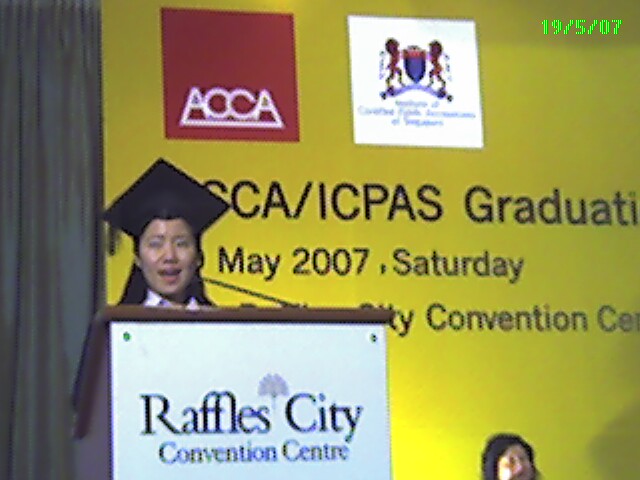
2007 May ACCA Graduation
Practical Experience Requirement (PER)
What is the current process called Student Training Record (STR)?
Answer – It is where you are required to match your practical experience AGAINST a set of competencies and record them accordingly.
What is the new PER?
Answer – You have to demonstrate that you have met a range of workplace performance objectives ie. benchmarks of effective performance.
What are these performance objectives?
Answer – 9 key and 4 optional performance objectives.
How to complete a performance objective?
Answer – You are to respond to a set of “challenge questions” for each objective online or paper-based.
When to complete the return?
Answer – Annually ie. last quarter of each year.
Who can be my workplace mentor?
Answer – It could be your line manager, mentor or another individual. If possible, select a qualified accountant, so as to avoid being priority flagged for monitoring purposes.
What is the purpose of having a workplace mentor?
Answer –
– select performance objective to work on
– setting targets
– provide access for you to tap on mentor’s experience for your overall development
– evaluate and review your progress
ICPAS Financial Highlights for YE 31 Dec 2006
Dear friends,
The info presented here and as always is, is to help to raise awareness of things surrounding you. This is also part of the training to review financial statements.
How much did ICPAS receive from its members?
Answer – It received $2.7mio (a drop of 3.6% against 2005) from its members.
How much surplus did SAA, the training arm of ICPAS, generate in 2006?
Answer – Despite having generated a healthy surplus of $1.9mio, it has declined significantly by 16% compared to 2005.
What is the overall bottomline then?
Answer – On the whole, ICPAS registered $1.5mio surplus (a negative 34% against 2005). The significant drop in surplus could be due to:-
- higher expenditure in marketing & promotion activities and;
- more than three-fold increase in deficit in the Practice Monitoring Division
Administrative expenses grew 25% to $4.07mio for 2006.
Cashflow
The most significant activity in 2006 which impacted ICPAS’s cashflow was the acquisition of City Campus for $15mio.
- Cash and cash equivalents declined from $7.8mio to $2.2mio.
- ICPAS entered into a finance lease position of $8mio.
Should you wish to review the full financial statements, you may approach the institute.
ACCA Qualification – Underlying Intention #2
Dear friends,
In this posting, I attempt to BRIEFLY explain the main intention of all these changes.
In one sentence – ACCA intends to hard implant key values ie. professional values, ethics and governance into all aspiring members-to-be.
These skills are essential as the profession moves towards strengthened codes of conduct, regulation and legislation with an increasing focus on professionalism and ethics in accounting.
They will be examined at every subject (where applicable, with different emphasis) till the highest level in the new ACCA Qualification. They will also be a core element of students’ practical experience requirements. This point was stressed repeatedly in the recent lecturers’ briefing.
The intent is demonstrated by the creation of the compulsory online practical Ethics module for all new students.
The focus on ethics is not uncommon. It is a singular subject to be passed in the CFA programme. Given the many accounting blow ups in the recent years, I don’t think we are doing enough yet.